
‘Red Roses for the Butcher’ CD
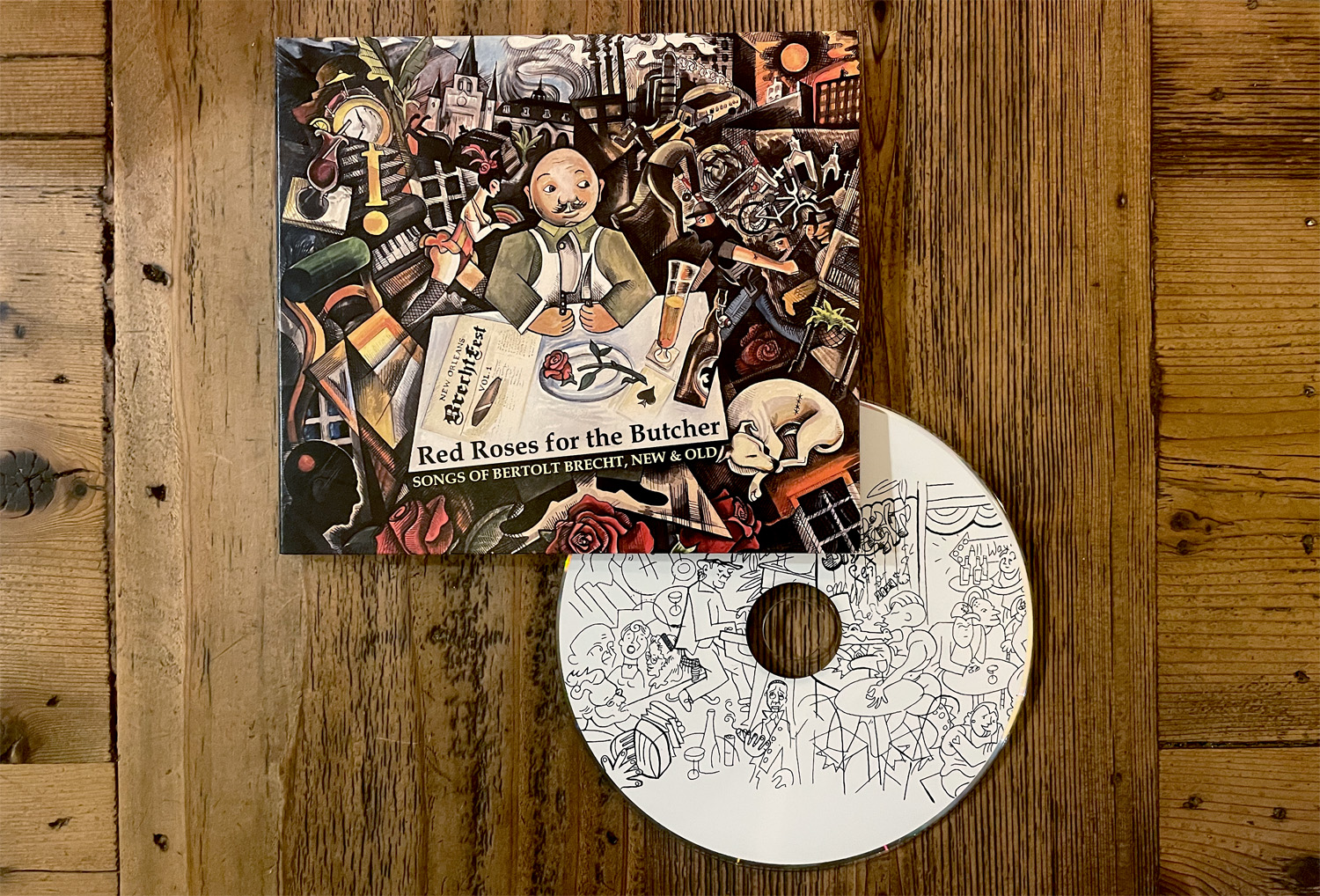
We are excited to announce that this unique music performed at the BrechtFest event will be available as a recording that people can hear more than once-a-year. The ‘Red Roses for the Butcher’ album has 12 songs presenting 5 never-before released original compositions set to the works of Brecht alongside creative arrangements of existing numbers.
Album Notes
1. Supply and Demand
From the play The Measures Taken. English lyrics by John Willet / Bremner Fletcher. Music by Hanns Eisler, arranged by David Symons.
Rice can be had down the river.
People in the remoter provinces need their rice.
If I can get that rice off the market
Rice gets more expensive.
Then the men who pull the barges must go short of rice
And I can sell my rice for even more.
Don’t ask me what rice is.
Don’t ask me my advice.
I’ve no idea what rice is
All that I know is its price.
In winter time the workers need warm clothing.
So I must buy cotton so that
I can keep cotton off the market.
When a cold spell comes, then clothes get more expensive.
And those workers, they earn too much money in my cotton factories anyway.
And cotton’s just so plentiful and cheap.
Don’t ask me what cotton is.
Don’t ask me my advice.
I’ve no idea what cotton is.
All that I know is its price.
Working men eat too much food.
That’s what makes them so expensive.
I hire new cooks, tell them “make the food more cheaply” but
The workers eat it anyway.
And now I need to hire more men for my factories.
Don’t ask me what a man is.
Don’t ask me my advice.
I’ve no idea what a man is.
All that I know is his price.
2. Sentimental Song No. 78
(1920) The only other “Sentimental Song” known is no. 1004, “Remembering Marie A”. English lyrics by John Willet. Music by David Symons.
Oh it was a night of loving
And I slept exhaustedly:
And I saw the greenness budding
In the sunshine on a tree.
And I thought, as I lay dreaming
Of the sunshine on that tree:
Underneath its branches greening
Let them one day bury me.
Waking then in spotless linen
With you lying next to me
I thought: here’s the shroud so clean in
Which I’ll have them bury me.
And the moon came softly streaming
Through the curtains onto me
And I lay quite silent, dreaming
When my burial would be.
Feeling then your warmth beside me
Little body, thigh and knee
In these arms, I thought, I’ll hide me
Here’s where they can bury me.
Like expectant heirs I say you
Round my bed weep many a tear.
If, I thought, I die tomorrow
They must let me disappear.
You gave much: I’ll make you sorry
That you didn’t give the lot:
And the malice you folk bore me –
Will be something you’ll regret.
3. Change the World
From the play The Measures Taken. English lyrics by Eric Bentley. Music by Hanns Eisler, arranged by David Symons.
With whom would the right minded man not sit down to help the right?
And what medicine would taste too bad to a dying man?
And what baseness would you not commit, could you rid the Earth of all baseness?
And if in the end you change the whole world, for what task are you too good?
For what task are you too good?
Sink down in the slime
Embrace the butcher:
But change the world, it needs it.
Who are you?
4. Song of the Little Wind
From the play Schweik in the Second World War. English lyrics by Eric Bentley. Music by Hanns Eisler, arranged by David Symons.
Eil Liebster, zu mir, teurer gast
Wie ich keinen bessern find
Doch wenn du mich im Arme hast
Dann sei nicht so geschwind.
Fly to my arms, oh welcome guest
Fly to me, I love you best
But when within your arms I lie
Then darling, do not fly.
Don’t miss the plums in the autumn:
That’s when they’re ripe, my boy.
And let the mighty storm bring you fear
And the little wind bring you joy.
Ach, Schnitter, lass es sein genug
Lass, Schnitter, ein’n Halm stehen.
Trink nicht dein Wein auf einen Zug
Und küss mich nicht im Gehen.
Oh, reaper, stop and now have done
Let one stalk remain upright.
Don’t drink your wine all in one gulp
And don’t kiss me in flight.
Such a little wind, it’s hardly there
Just a rocking in the air
Like what the plums want from the tree:
On the ground they want want to be.
Don’t miss the plums in the autumn:
That’s when they’re ripe, my boy.
And let the mighty storm bring you fear
And the little wind bring you joy.
5. Ballad of the Button
From the play The Round Heads and the Pointed Heads. English lyrics by John Willet / Harry Mayronne. Music by Harry Mayronne.
Silly man comes up to me
And he asks me doubtfully
Will his wealthy brother see him right?
I reply: Undoubtedly he might.
Then I quickly rip a button from his collar
And I say: Here’s your fortune-teller.
Now let’s see:
If the button hole comes down heads you
Can be certain he’s misled you
And prefers his luxury.
Let’s see if Lady Luck is smiling
And I toss it and say: Sorry, darling.
When they say that the hole seems to
Go right through, you’ll hear me say: That’s true.
And it’s no good trying to buck the system.
Don’t complain if you want peace and quiet.
If you really hope for his assistance
Tell your brother you’re prepared to buy it.
Working man comes up to me
And he tells me angrily
Rich man’s knocking down his garden fence
Do I think he can get recompense?
So I quickly rip a button from his collar
And I say: Here’s your fortune-teller.
Now let’s see:
If the button hole comes down heads
You’ll never get the money paid you
So you’d better let things be.
Let’s find if Lady Luck is smiling.
Then I toss it, and I say: No, darling.
When they say: but the hole seems to
Go right through, you’ll hear me say: That’s true.
Then I say: it’s no use trying to buck the system.
That’s the law, so go on and apply it.
Justice is a fraud. You’d better listen:
Right or wrong, you’re going to have to buy it.
6. Hitler Chorale I
Parody of the 1630 Lutheran hymn “Now Thank We All Our God”. Melody by Johann Crüger, arranged by David Symons.
Now thank we all our God
For sending Hitler to us;
From Germany’s fair land
To clear away the rubbish
We’ve done with the old ways
The new paint’s spick and span
So thank we all our God
Who sent us such a man.
The house was far too old
It let in wind and weather.
We’d soon have had to build
A new one altogether.
We thought the house would fall
Its rottenness was plain
But Hitler paints it all
So it stands firm again.
The rich possess the bread.
The poor are almost fainting.
O merciful Godhead
We sorely need repainting
Lest the poor man should think
His hunger pang to still
And fall upon the rich
At last to eat his fill.
But when our Hitler comes
He will redecorate us
Let each stay rich or poor
According to his status.
He’ll see that class remains
But never leads to hate.
He’ll make sure that it rains
But nobody gets wet.
He’ll make the vinegar sweet
And make the sugar sour
From cracks in the concrete
He’ll make a lofty tower.
He’ll paint the filth and rot
Until it’s spick and span
So thank we all our God
For sending us this man.
7. Epitaph, 1919
Poem about the revolutionary leader Rosa Luxemburg, murdered by the government-sponsored paramilitary Freikorps. Included in the Berlin Requiem cantata, though sometimes replaced by the less politically controversial Marterl. Music by Kurt Weill, arranged by David Symons. Clarinet solo by Susanne Ortner.
Die rote Rosa nun auch verschwand.
Wo sie liegt, ist unbekannt.
Weil sie den Armen die Wahrheit gesagt
Haben die Reichen sie aus der Welt gejagt.
Red Rosa also, it seems, has gone.
She is dead, and where she now lies is quite unknown.
She told the poor the truth with such insistence
The rich removed her from this existence.
Rest in peace.
Ruhe sanft.
8. Hitler Chorale III
Parody of the 1658 Lutheran hymn “O Sacred Head, Sore Wounded”. Original tune by Hans Leo Hassler, altered by Johann Crüger, arranged by David Symons based on J.S. Bach’s harmonization in the St. Matthew Passion.
O Calf so often wounded
Direct your steps to where
His knife is being sharpened
Whose dearest charge you are.
He who devised new crosses
On working men to lay
He’ll find a way to butcher
You too some sunny day.
In his sight you’ve found favor
O anxious, panting calf.
It’s you above all others
He’s claiming for himself.
Just wait in hope not fretting
Nor try to jump the queue
For now his knife he’s whetting
He’ll soon be calling you.
The great industrial captains
Need you for their vast plan.
You have not been forgotten
They want you, little man.
And if, O Calf, you’re slaughtered
Then is your glory sure
It shows how well you’re thought of
It’s what you were made for.
O Calf whom he has chosen
You wandered far and wide
You searched and failed to find him
And now he’s by your side.
After long years he’s found you
You’ve reached your goal at last.
The butcher’s arms are round you
He holds you to him fast.
9. To My Countrymen
(1949) English lyrics by H. Arthur Klein / David Buchbinder. Music by David Buchbinder.
You who survive in cities that have died
Now show some mercy to yourselves at last.
Don’t march, poor things, to war as in the past
As if past wars left you unsatisfied.
I beg – mercy for yourselves at last.
You men, reach for the spade and not the knife.
You’d sit in safety under roofs today
Had you not used the knife to make your way
And under roofs one leads a better life.
I beg you, take the spade and not the knife.
You must speak out and tell your parents plain.
You will not live in ruins once again
Nor undergo what they’ve had to endure.
You children, to be spared another war.
I beg you, take the spade and not the knife.
I beg you, mercy for yourselves at last.
10. Questions
An English sonnet, written for Brecht’s collaborator and lover Margarete Steffin. English lyrics by Naomi Replansky. Music by David Symons.
Write me what you’re wearing. Are you warm?
Write me how you sleep. Is your bed soft?
Write me how you look. Are you the same?
Write me what you miss. Is it my arm?
Tell me: are the letting you alone?
Can you hold out? What will their next move be?
What are you doing? Is it what should be done?
What are you thinking of? Is it of me?
Questions are all that I can give you, and
I take what answers come, because I must.
If you are tired, I can’t give you a hand;
Or, hungry, feed you. Thus, it is as though
I were not in the world, did not exist.
It is as though I had forgotten you.
11. What Does a Man Live By?
From the play The Threepenny Opera. English lyrics by John Willet / Eric Bentley. Music by Kurt Weill, arranged by David Symons.
You Gentlemen who think you have a mission
To save us from the seven deadly sins
Should first sort out the basic food position
Then start your preaching. That’s where it begins.
You lot who preach restraint and watch your waist as well
Should learn for once the way the world is run
However much you twist, whatever lies you tell
Food is the first thing. Morals follow on.
So first make sure that those who are now starving
Get proper helpings when we all start carving
What does a man live by? By resolutely
Ill-treating, beating, cheating, eating some other bloke.
A man can only live by absolutely
Forgetting he’s a man like other folk.
For once you must try not to shirk the facts:
Mankind is kept alive by bestial acts.
You say that girls may strip with your permission.
You draw the line dividing art from sin.
So first sort out the basic food position
Then start you preaching, that’s where we begin.
You men who bank on your desires and our disgust
Should learn for all time how the world is run:
Whatever lies you tell, how ever much you twist
Food is the first thing. Morals follow on.
So first make sure that those who are now starving
Get proper helpings when we all start carving
What does a man live by? By resolutely
Ill-treating, beating, cheating, eating some other bloke.
A man can only live by absolutely
Forgetting he’s a man like other folk.
For once you must try not to shirk the facts:
Mankind is kept alive by bestial acts.
12. Song of the Rose
From the play Mother Courage. English lyrics by W.H. Auden. Music by David Symons.
The red garden rose we planted
Has fair and stately grown;
Our fondest hopes were granted.
Scarlet heavy-scented flowers
Beguiled our summer hours:
Blessed those are who a garden own
Where such a rose tree flowers.
Though, through the pine woods wailing
The winter wind makes moan
Its rage is unavailing.
Long before the autumn ended
Our roof with tiles we mended:
Blessed those are who a roof still own
When such a wind comes wailing.